Overview
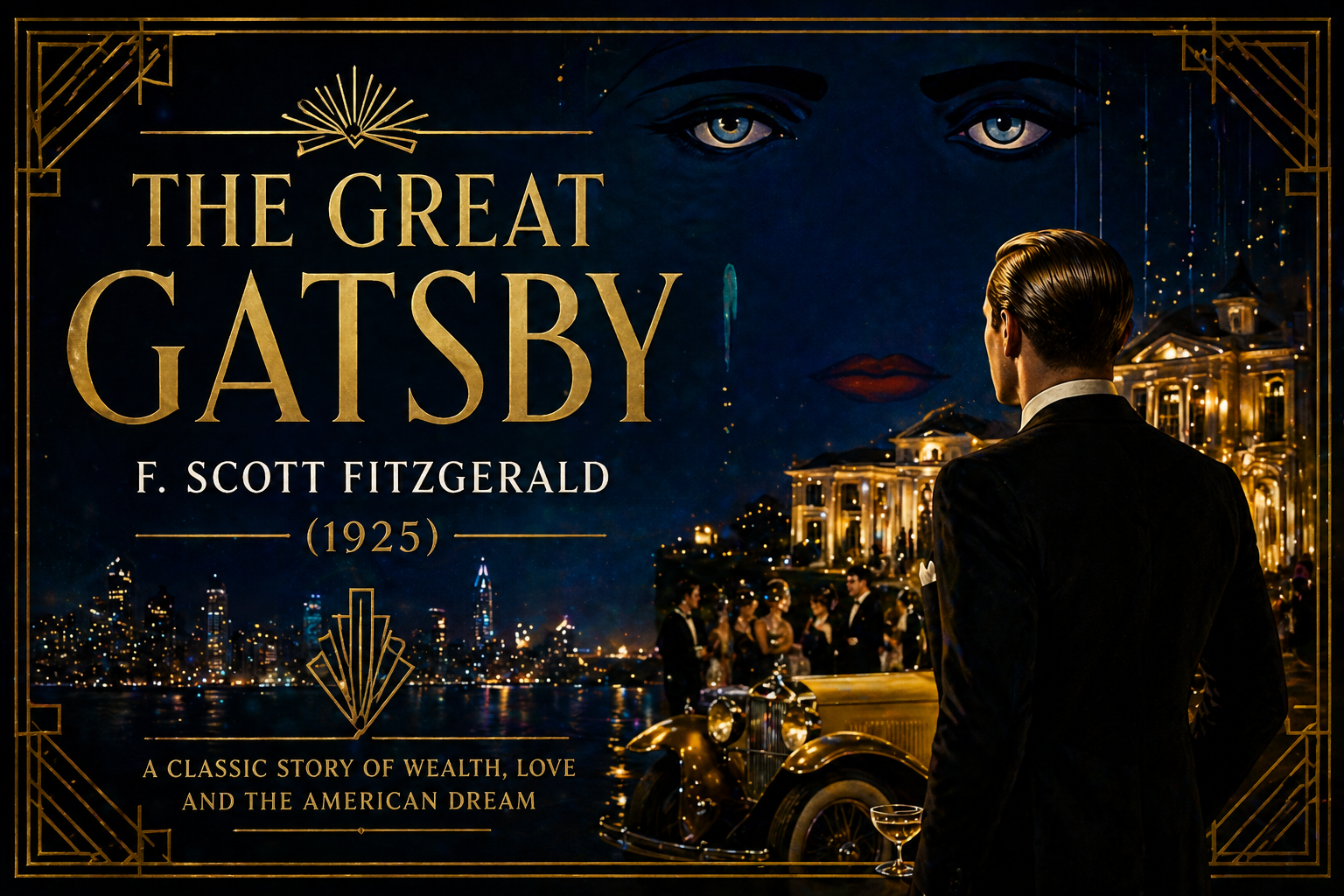
Set in the summer of 1922 on Long Island and New York City, The Great Gatsby is a tragic tale of wealth, obsession, and the illusion of the American Dream. It is narrated by Nick Carraway, a Yale-educated Midwesterner who moves to New York to work in the bond business.
Key Characters
- Nick Carraway – The narrator; a moral, observant outsider
- Jay Gatsby – A mysterious, fabulously wealthy man obsessed with the past
- Daisy Buchanan – Nick’s cousin; the object of Gatsby’s obsession; beautiful but shallow
- Tom Buchanan – Daisy’s arrogant, brutish, and unfaithful husband
- Jordan Baker – A professional golfer and Nick’s love interest; dishonest by nature
- Myrtle Wilson – Tom’s working-class mistress
- George Wilson – Myrtle’s husband; a broken, tragic figure
Plot Summary
Act I – The World of East and West Egg Nick moves to West Egg, a nouveau-riche neighborhood, next door to the lavish mansion of the enigmatic Jay Gatsby. Across the bay in the more aristocratic East Egg lives his cousin Daisy and her husband Tom. Nick soon discovers Tom is having an affair with Myrtle Wilson, a mechanic’s wife from the impoverished “Valley of Ashes.”
Act II – Gatsby Revealed Gatsby throws extravagant parties every weekend, yet remains mysterious. He befriends Nick and reveals his true motive — he is still deeply in love with Daisy, whom he dated five years ago before going to war. He has built his entire fortune and lifestyle to win her back. Nick arranges a reunion between Gatsby and Daisy, and the two rekindle their romance.
Act III – The Dream Unravels As Gatsby and Daisy’s affair deepens, tension rises with Tom. During a confrontation in New York City, Gatsby insists Daisy never loved Tom and wants her to leave him. Daisy is unable to fully commit. On the drive home, Daisy (driving Gatsby’s car) accidentally strikes and kills Myrtle Wilson. Gatsby covers for her, taking the blame.
Act IV – Tragedy Strikes Consumed by grief and manipulated by Tom, George Wilson believes Gatsby killed his wife. He shoots Gatsby dead in his pool, then turns the gun on himself. Gatsby dies alone — none of his party guests attend his funeral. Daisy and Tom quietly flee, indifferent to the destruction they caused. Nick, disillusioned, returns to the Midwest.
Central Themes
| Theme | Meaning |
|---|---|
| The American Dream | Gatsby’s rise symbolizes its promise — but his fate exposes its hollowness |
| Class & Old vs. New Money | East Egg (old money) looks down on West Egg (new money), no matter how rich |
| Illusion vs. Reality | Gatsby’s entire life is a carefully constructed fantasy |
| The Past | Gatsby is destroyed by his inability to let go — “Can’t repeat the past? Why of course you can!” |
| Moral Decay | The wealthy are careless people who “smashed up things and creatures and then retreated back into their money” |
Famous Closing Line
“So we beat on, boats against the current, borne back ceaselessly into the past.”
This metaphor captures the novel’s core tragedy — humanity’s futile struggle against time and the impossibility of recapturing the past.
Why It Still Matters
Written in 1925, the novel remains a timeless critique of wealth without virtue, the seductive lie of reinvention, and how the American Dream can corrupt the soul. Gatsby is not just a man — he is a symbol of every dreamer who confuses accumulation with fulfillment.