Overview
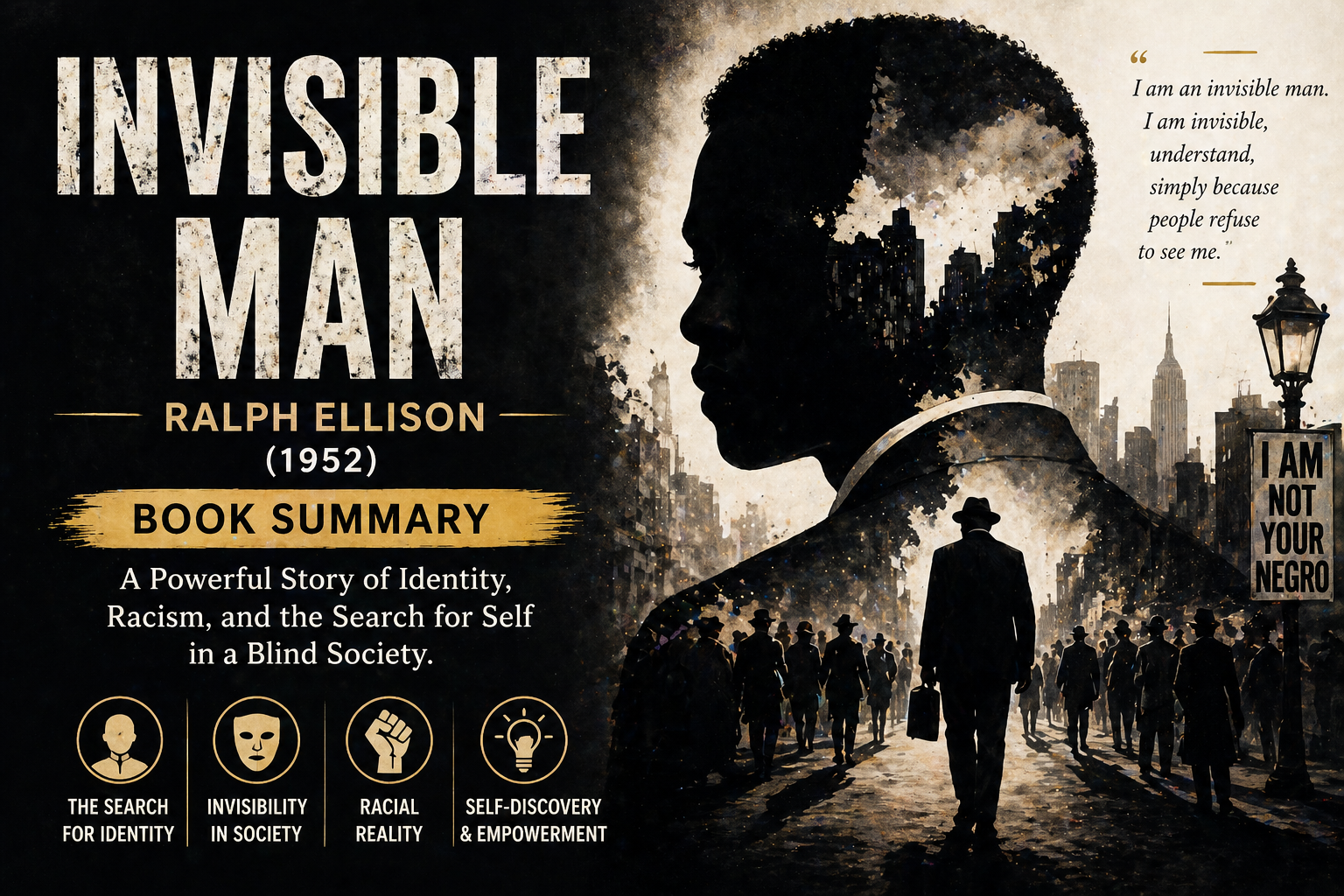
Invisible Man is one of the most powerful and groundbreaking novels in American literary history. It tells the story of a nameless Black man living in America who is “invisible” — not literally, but because society refuses to see him as a full human being. The novel is a searing journey through racism, identity, betrayal, and the desperate search for selfhood in a world that denies your very existence. It won the National Book Award in 1953 and is widely considered one of the greatest American novels ever written.
The Narrator — Why He Has No Name
The narrator is never given a name throughout the entire novel. This is deeply intentional. He represents every Black man in America — stripped of individual identity by a racist society that sees only his race, never his humanity. He is “invisible” because people look at him and see only what they want to see — a stereotype, a threat, a tool — never a person.
Key Characters
| Character | Role |
|---|---|
| The Narrator (Invisible Man) | A young, idealistic Black man searching for identity and purpose |
| Dr. Bledsoe | The powerful, manipulative Black president of the narrator’s college |
| Brother Jack | Leader of the Brotherhood; uses the narrator for political gain |
| Ras the Exhorter | A radical Black nationalist who sees the Brotherhood as a betrayal |
| Tod Clifton | A brilliant Brotherhood member whose tragic fate shakes the narrator deeply |
| Rinehart | A mysterious figure who lives multiple identities simultaneously |
| Norton | A wealthy white trustee of the college; represents white liberal hypocrisy |
| Mary Rambo | A kind Harlem woman who shelters the narrator; represents genuine Black community |
Plot Summary
Prologue — The Underground Man
The novel opens in a startling, unforgettable way. The narrator tells us he lives underground — in a basement illuminated by 1,369 light bulbs, powered by electricity stolen from the city. He plays Louis Armstrong’s “What Did I Do to Be So Black and Blue” on repeat. He is not mad. He is not hiding in shame. He is thinking — preparing to tell us his story, the story of how he became invisible.
This prologue immediately establishes the novel’s tone: surreal, angry, philosophical, and deeply alive.
Part I — The South: The Battle Royal
The narrator is a young, gifted Black man in the American South. He has just given a brilliant speech and is invited to deliver it before the town’s most important white men — businessmen, politicians, pillars of the community.
But first, he is forced to participate in a Battle Royal — a brutal, humiliating spectacle where blindfolded Black boys are made to fight each other savagely for the entertainment of laughing white men. After the bloody fight, the boys scramble on an electrified rug for fake gold coins, shocking themselves while the white men roar with laughter.
Only then is the narrator allowed to give his speech — bloodied, humiliated, still smiling — about the importance of humility and cooperation for Black advancement. The white men reward him with a briefcase and a scholarship to a Black college. He dreams that night that the briefcase contains a note reading:
“To Whom It May Concern: Keep This Nigger-Boy Running.”
This dream foreshadows everything that follows — a life spent running at other people’s command, never his own.
Part II — The College: Dr. Bledsoe’s Betrayal
At the Black college — modeled on Tuskegee Institute — the narrator is an ambitious, idealistic student. He deeply admires Dr. Bledsoe, the powerful Black president, seeing him as a model of Black success and dignity.
When the narrator is assigned to drive a wealthy white trustee named Mr. Norton, a series of misadventures exposes Norton to the uncomfortable realities of Black life — including a local man named Jim Trueblood who has impregnated his own daughter, and a chaotic veterans’ hospital. Norton is shaken.
Dr. Bledsoe is furious. Rather than defending the narrator, he expels him — but secretly, hypocritically. He gives the narrator letters of supposed recommendation to take to New York, pretending to help him find work. In truth, the letters tell every recipient that the narrator is not to be helped under any circumstances.
Bledsoe’s lesson is devastating: the most dangerous obstacle to Black progress is sometimes Black men in power who protect their own position by keeping others down. Power corrupts regardless of race.
Part III — New York: The Factory and the Hospital
The narrator arrives in New York City full of hope, only to discover Bledsoe’s betrayal when one honest man finally shows him the truth of the letters. Humiliated and broke, he finds work at Liberty Paints — a factory that makes the whitest white paint in America, ironically called “Optic White.”
The paint’s secret ingredient? Ten drops of black chemical added to every bucket of white. Without the black, the white is grey and dull. The symbolism is unmistakable — Black labor, Black creativity, Black existence is the invisible foundation that holds white America together, yet remains unacknowledged and unseen.
The narrator is injured in a factory explosion and wakes up in the company hospital, subjected to an experimental electric shock treatment — a chilling echo of the Battle Royal’s electric rug. The doctors debate whether to lobotomize him. They treat him as a medical object, not a human being. He escapes, barely himself.
He is taken in by Mary Rambo, a warm, generous Harlem woman who represents the authentic, nurturing heart of the Black community — asking for nothing, giving everything.
Part IV — Harlem: The Brotherhood
Recovering in Harlem, the narrator spontaneously gives a passionate speech defending an elderly Black couple being evicted from their home. His oratory is electrifying. He is recruited by Brother Jack into the Brotherhood — a powerful, organized political movement (clearly modeled on the American Communist Party) that claims to fight for racial equality and social justice.
The narrator rises quickly within the Brotherhood, becoming a powerful speaker and community organizer in Harlem. For a while, he believes he has finally found his purpose — a community, a cause, a sense of visibility.
But cracks appear. The Brotherhood is run almost entirely by white men who treat Black members as instruments of their political agenda, not as equal partners. When the narrator begins to speak from his own experience and emotion, the Brotherhood criticizes him for being too individualistic — they want him to speak their ideology, not his truth.
The narrator is transferred away from Harlem to a different assignment — and in his absence, Harlem suffers. The Brotherhood has strategically abandoned the Harlem community for broader political calculations, using and discarding Black people just as every other white institution has done.
Part V — Tod Clifton’s Death and the Turning Point
The narrator discovers that Tod Clifton — once one of the Brotherhood’s most brilliant and promising Black members — has left the organization and is now selling Sambo dolls on the street corner. These paper dancing dolls, controlled by an invisible black thread, are a grotesque symbol of Black dehumanization — the puppet who dances for white entertainment.
Tod Clifton is shot and killed by a policeman in a sudden, senseless act of brutality. The narrator organizes a massive, moving funeral procession for Clifton — without the Brotherhood’s permission. The Brotherhood is furious, accusing the narrator of making the funeral political. But for the narrator, it is the opposite — Clifton’s death is proof that the Brotherhood never truly valued Black lives.
This moment breaks something open in the narrator. He begins to see the Brotherhood for what it is — another system that uses Black people as pawns.
Part VI — Rinehart and the Revelation
Fleeing danger in Harlem, the narrator puts on a hat and dark glasses — and is immediately mistaken for a man named Rinehart. He discovers that Rinehart is simultaneously a numbers runner, a pimp, a preacher, and a briber — a man who wears a hundred different identities with ease.
Rinehart is a revelation. If the world insists on seeing only what it wants to see, perhaps the solution is not to fight it — but to use its blindness. If society assigns you an identity regardless of who you are, perhaps you can inhabit any identity, all identities, none of them.
This is both liberating and terrifying — the freedom of invisibility, but also the emptiness of having no self at all.
Part VII — The Harlem Riot and the Fall Underground
Harlem erupts into a massive race riot — which the narrator eventually realizes was subtly engineered by the Brotherhood itself, as a calculated political sacrifice of the Black community for larger ideological goals. The Brotherhood used Black anger, Black pain, and Black lives as fuel for their own agenda.
During the riot chaos, the narrator is chased by Ras the Exhorter — now calling himself “Ras the Destroyer” — a Black nationalist who sees the narrator as a traitor to his race for working with the Brotherhood. The narrator falls into a manhole and cannot escape. He burns the contents of his briefcase — the paper slave-chain of documents he has carried since the Battle Royal — to light his way. Inside, he finds that every document, from every person who ever claimed to help him, was in fact a tool of control.
He decides to stay underground. To think. To write. To become himself.
Epilogue — Emergence
The narrator ends where he began — underground, surrounded by light. But now he is ready to emerge. He has moved through three stages of consciousness:
- Naive belief — that hard work and humility would earn him dignity
- Political belief — that organized ideology would give him purpose
- Self-knowledge — that he must define himself on his own terms
He writes:
“I am an invisible man… I am not complaining, nor am I protesting either. It is sometimes advantageous to be unseen, although it is most often rather wearing on the nerves.”
And finally, in the novel’s most haunting closing question, he asks:
“Who knows but that, on the lower frequencies, I speak for you?”
Central Themes
| Theme | Deep Meaning |
|---|---|
| Invisibility | Not physical but social — the refusal of white America to see Black Americans as full human beings |
| Identity | The narrator’s entire journey is a search for a self that belongs to him, not assigned by others |
| Betrayal by Institutions | Every institution — the college, the factory, the Brotherhood — exploits and discards the narrator |
| Race and Power | Both white and Black power structures can oppress — power itself is the corrupting force |
| The American Dream’s Lie | Hard work, eloquence, and ambition are not enough when the system is designed against you |
| Individuality vs. Collectivism | The Brotherhood demands he suppress his individuality — but selfhood cannot be surrendered |
| Blindness | Almost every white character is “blind” — unable or unwilling to see Black humanity |
Symbolism
| Symbol | Meaning |
|---|---|
| 🔆 1,369 Light Bulbs | Blazing light in darkness — the narrator refusing to remain unseen even underground |
| 🎨 Optic White Paint | Black labor as the invisible foundation of white America’s success |
| 🪆 Sambo Dolls | The dehumanizing puppet role society wants Black men to play |
| 💼 The Briefcase | The weight of others’ expectations and control; a chain disguised as opportunity |
| 🥊 The Battle Royal | America’s demand that Black men humiliate themselves for white amusement before being given anything |
| 🕶️ Rinehart’s Disguise | The freedom — and emptiness — of invisibility; the fluidity of identity |
🔍 Hidden Facts Most People Don’t Know
1. Ellison Wrote It in a Barn in Vermont Ralph Ellison began writing Invisible Man in a barn in Waitsfield, Vermont — far from the Harlem streets he was depicting. The physical distance gave him the clarity to write about Black urban life with both intimacy and philosophical depth.
2. It Took Seven Years to Write Ellison worked on Invisible Man from 1945 to 1952 — seven years of relentless revision. He was a perfectionist who rewrote entire sections multiple times, which is why every sentence feels intentional and loaded with meaning.
3. The Opening Line Came First — Everything Else Was Built Around It Ellison has said that the line “I am an invisible man” came to him suddenly and fully formed. He then spent years building the entire novel backwards and forwards from that single sentence. The whole book is essentially an answer to that opening declaration.
4. It Was Almost Not Published Multiple publishers rejected the manuscript. When Random House finally accepted it, editors were uncertain how American audiences would respond to such an unflinching portrayal of racism. It became an instant classic and won the National Book Award the very next year — in 1953.
5. Ellison Never Finished His Second Novel Despite living until 1994, Ellison spent 42 years trying to write his second novel. A fire destroyed hundreds of pages of his manuscript in 1967. He never recovered creatively from that loss. The incomplete novel was published posthumously as Juneteenth in 1999. Invisible Man remains his singular masterpiece.
6. The Brotherhood is Deliberately the Communist Party Ellison was himself briefly involved with the American Communist Party in the 1930s and was deeply disillusioned. The Brotherhood is his fictional but thinly veiled critique of how the Communist Party used Black Americans and Black suffering as political currency while never truly committing to racial equality.
7. It Predicted the Civil Rights Movement Published in 1952 — two years before Brown v. Board of Education and three years before Rosa Parks — the novel diagnosed with stunning precision exactly why the Civil Rights movement would need to happen, and what it would be fighting against.
Final Takeaway
Invisible Man is not merely a novel about race — it is a novel about what it means to be a human being in a world that refuses to see you. The narrator’s invisibility is a condition that, as he suggests in his final line, speaks to everyone who has ever been overlooked, misused, or reduced to a symbol by the world around them.
The novel’s ultimate message is both painful and profoundly hopeful: you cannot find yourself in the mirror others hold up to you. Identity must be built from within — carved out of experience, suffering, reflection, and the hard-won courage to say:
“I am. Regardless of what you see — I am.”