Overview
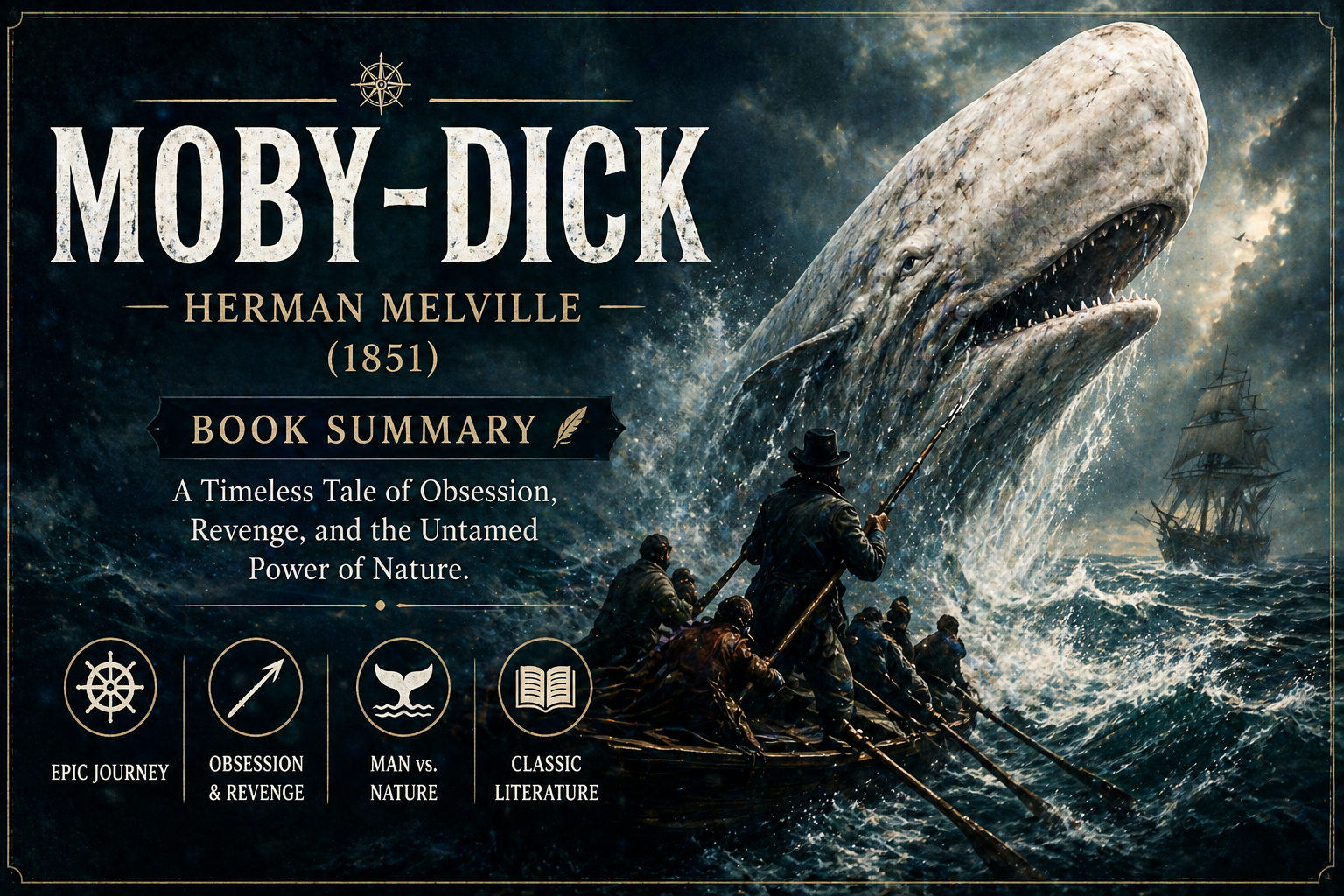
Moby-Dick is one of the greatest and most ambitious novels in American literature. It tells the story of Captain Ahab’s monomaniacal quest to hunt and kill a legendary white sperm whale — Moby Dick — who had previously destroyed his ship and severed his leg. Narrated by the sailor Ishmael, the novel blends thrilling adventure with deep philosophy, theology, and symbolism.
Key Characters
| Character | Role |
|---|---|
| Ishmael | The narrator; a reflective, philosophical sailor |
| Captain Ahab | The obsessed, tyrannical captain of the Pequod |
| Moby Dick | The great white whale; Ahab’s nemesis |
| Starbuck | First mate; the voice of reason and morality |
| Queequeg | Ishmael’s best friend; a noble, tattooed harpooner |
| Stubb | Second mate; cheerful and fatalistic |
| Flask | Third mate; reckless and unthinking |
| Pip | A young Black cabin boy who goes mad after being abandoned at sea |
| Fedallah | Ahab’s mysterious Persian harpooner; a shadowy prophet |
Plot Summary
Part I — Setting Sail
The novel opens with one of literature’s most iconic lines:
“Call me Ishmael.”
Ishmael, a wandering sailor, arrives in New Bedford, Massachusetts, seeking work on a whaling ship. He befriends Queequeg, a tattooed Polynesian harpooner, and the two become inseparable companions. Together they sign aboard the Pequod, a weathered whaling ship out of Nantucket, owned by Captains Peleg and Bildad.
Before departure, a mysterious prophet named Elijah warns Ishmael about the Pequod’s captain, hinting at doom ahead — but Ishmael ignores the warning.
Part II — Ahab’s Obsession Revealed
Once at sea, Captain Ahab finally emerges on deck — a towering, scarred man with a leg carved from whale ivory. He gathers the crew and nails a gold doubloon to the mast, declaring it the reward for whoever first spots Moby Dick — the white whale who bit off his leg on a previous voyage.
Ahab’s speech electrifies the crew:
“Death to Moby Dick! God hunt us all, if we do not hunt Moby Dick to his death!”
Starbuck, the moral first mate, protests — whaling is a business, not a mission of vengeance. But Ahab’s charisma overwhelms the crew’s reason. Even Starbuck, despite his misgivings, cannot stop what is coming.
Part III — The Voyage Itself
Melville uses the long voyage across the Atlantic, Indian, and Pacific Oceans to explore an enormous range of topics:
- 🐋 The science and anatomy of whales — entire chapters are devoted to whale biology, whale species, and the mechanics of whaling
- ⚓ The art of whaling — harpooning, rendering blubber, reading the seas
- 🌊 The nature of the ocean — its beauty, its indifference, its terror
- 🧠 Philosophy and fate — free will vs. destiny, man vs. nature, good vs. evil
The Pequod encounters nine other ships (called “gams”) during the voyage. Each encounter deepens the symbolism:
- Some ships have already faced Moby Dick and bear his scars
- Captains warn Ahab to turn back
- Ahab ignores every warning, growing more consumed by his obsession
Meanwhile, Pip, a young cabin boy, falls overboard and is momentarily abandoned. He survives but loses his sanity — drifting in the infinite ocean breaks his mind. Pip becomes a haunting symbol of innocence destroyed by the voyage’s madness.
Part IV — The White Whale’s Symbolism
Melville spends an entire chapter (“The Whiteness of the Whale”) exploring what Moby Dick means. The whale’s whiteness is terrifying not because it represents evil, but because it represents the void — the absence of meaning, the blankness of the universe.
To different characters, Moby Dick symbolizes different things:
- To Ahab → pure evil; the embodiment of all suffering in the universe
- To Starbuck → just a dumb animal; Ahab’s obsession is madness
- To Ishmael → the unknowable; nature’s sublime indifference to humanity
- To the crew → adventure, profit, fate
Part V — The Final Chase (Three Days)
Day One: Moby Dick is finally spotted. Ahab himself cries “There she blows!” The boats are lowered. The white whale attacks — smashing Ahab’s boat to splinters. But Ahab survives, and his obsession only intensifies.
Day Two: The chase continues. Moby Dick attacks again, destroying more boats, injuring men. Starbuck begs Ahab to stop:
“See! Moby Dick seeks thee not. It is thou, thou, that madly seekest him!”
Ahab refuses. He is beyond reason now.
Day Three: The final, devastating confrontation. Moby Dick rams the Pequod itself — the great ship begins to sink. In his last act, Ahab hurls his harpoon at the whale, crying:
“To the last I grapple with thee; from hell’s heart I stab at thee!”
The harpoon line coils around Ahab’s neck and drags him into the sea. The Pequod sinks, pulling the entire crew down with it — into a whirlpool described as the ocean swallowing the ship like a soul into oblivion.
Only Ishmael survives, clinging to Queequeg’s coffin — which floats up from the wreckage and saves him. He drifts alone until rescued by another ship, the Rachel, itself searching for its own lost crew.
Central Themes
| Theme | Deep Meaning |
|---|---|
| Obsession & Revenge | Ahab’s hatred destroys not just himself but everyone around him — a warning about how personal vengeance corrupts leadership and reason |
| Man vs. Nature | Nature (the whale, the sea) is not evil — it is simply indifferent. Mankind’s arrogance in trying to conquer it leads to ruin |
| Free Will vs. Fate | Are Ahab and the crew making choices, or are they fated from the start? Melville leaves this deliberately unresolved |
| God & the Universe | The novel questions whether the universe has meaning or purpose — Moby Dick’s whiteness suggests a godless, indifferent cosmos |
| The American Spirit | Ahab is both a heroic and tragic symbol of American ambition — bold, visionary, but fatally overreaching |
| Isolation & Madness | Ahab’s isolation from human connection (Pip, Starbuck, even his own wife) accelerates his destruction |
| Race & Democracy | The Pequod’s multicultural crew (Polynesian, African, Asian, Native American) is a radical portrait of democratic America — united, yet led to doom by one man’s ego |
Symbolism
- 🐋 Moby Dick → The unknowable, God, nature, fate, or the ultimate limits of human understanding
- ⚓ The Pequod → America itself — diverse, ambitious, ultimately fragile
- 🦷 Ahab’s ivory leg → His wound that never healed; the trauma that defines him
- ⚰️ Queequeg’s coffin → Death that becomes salvation; the only thing that saves Ishmael
- 🪙 The gold doubloon → Each character sees something different in it — a mirror of their own soul
- 🌊 The ocean → The unconscious mind; the vast, uncontrollable forces beneath human life
Why It Is Called a Great American Novel
| Reason | Explanation |
|---|---|
| Epic Scope | It tackles nothing less than humanity’s place in the universe |
| Democratic Vision | Every voice on the Pequod matters — from captain to cabin boy |
| The American Dream Critique | Like Gatsby, Ahab’s limitless ambition leads to self-destruction |
| Linguistic Brilliance | Melville’s prose ranges from Shakespearean tragedy to scientific essay to comedy — unlike anything before it |
| Prophetic Power | Written in 1851, it predicted America’s obsessive, self-destructive pursuit of power and dominance |
Famous Lines
“Call me Ishmael.” — the most famous opening line in American literature
“It is not down on any map; true places never are.”
“We cannot live only for ourselves. A thousand fibers connect us with our fellow men.”
“To produce a mighty book, you must choose a mighty theme.”
Final Takeaway
Moby-Dick is ultimately a story about what happens when a human being refuses to accept the limits of existence — when personal pain becomes a war against the universe itself. Ahab is magnificent and terrifying, a hero and a monster. The whale does not hate him. The sea does not punish him. The universe simply does not care — and that is the most terrifying truth of all.
Ishmael survives because he watches, wonders, and stays humble before the mystery of life. That is Melville’s quiet message: curiosity saves; obsession destroys.