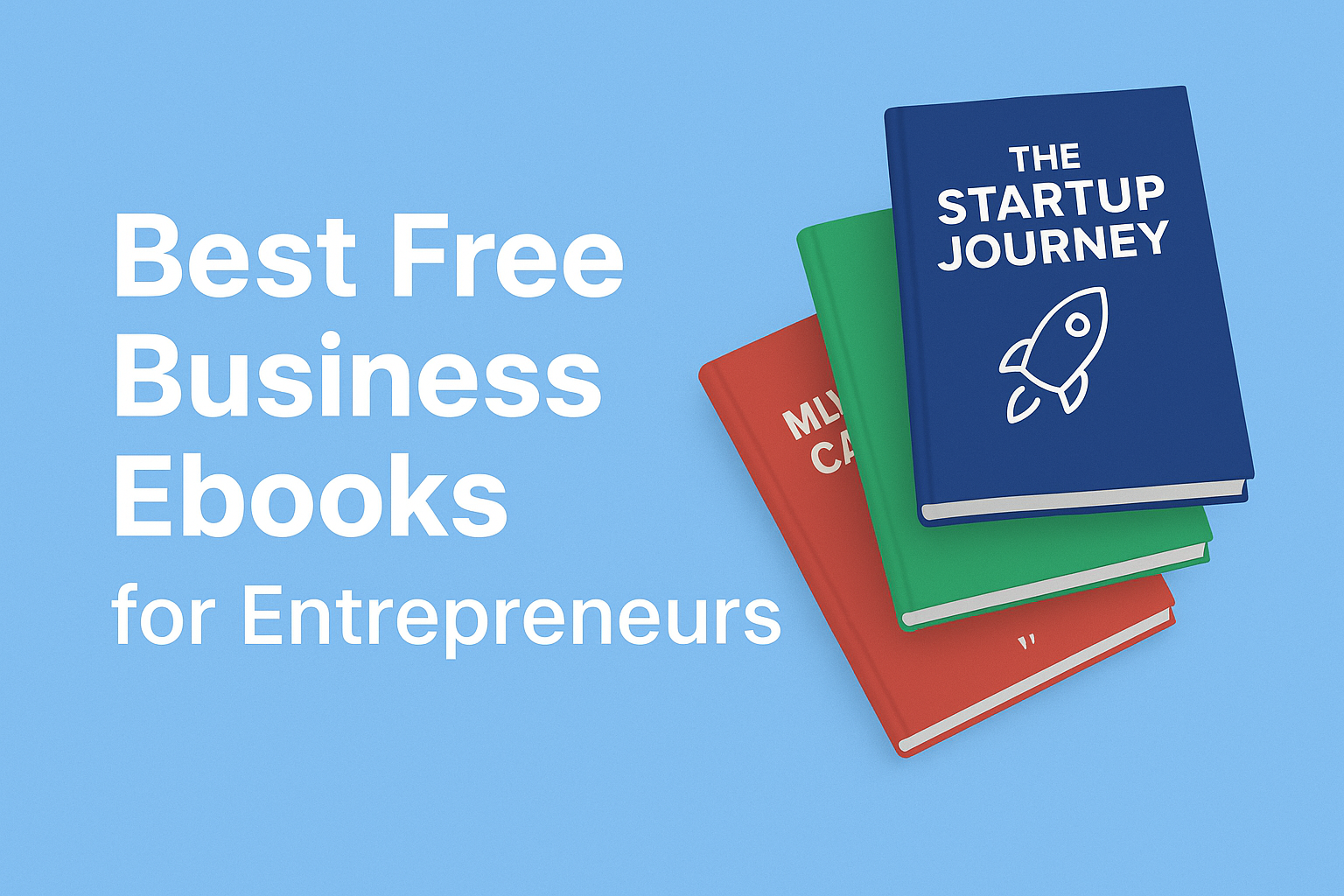
Grow Faster. Learn Smarter. Zero Cost.
Grow Faster. Learn Smarter. Zero Cost.
Starting or scaling a business is challenging — especially when you don’t have access to the right knowledge. But the good news? Today, entrepreneurs can learn almost everything for free through high-quality business ebooks.
Whether you’re building an ecommerce brand, a local startup, or a side hustle, free ebooks can help you master topics like marketing, branding, finance, productivity, leadership, and more.
In this guide, we’ve curated the best free business ebooks every entrepreneur should read in 2025. These ebooks are from trusted global sources like HubSpot, Shopify, Google, and Harvard — and each book also comes with a cover image (as you requested).
Let’s begin.
1. The Startup Journey: A Beginner-Friendly Guide for New Founders
Best for: New founders, students, first-time entrepreneurs
Category: Startup fundamentals
Starting a business can feel like standing at the edge of a cliff—exciting, terrifying, and full of unknowns. Whether you’re a student with a dorm-room idea, a professional dreaming of independence, or simply someone tired of the 9-to-5 grind, the entrepreneurial path is one of the most rewarding adventures you can take.
“The Startup Journey: A Beginner-Friendly Guide” is the perfect starting point. Written in plain language and free of intimidating jargon, it’s the handbook every first-time founder wishes they had from day one.
Who Is This Guide For?
- Aspiring Founders with a spark of an idea but no clue where to start.
- Students & Recent Graduates exploring entrepreneurship as a career path.
- Side Hustlers ready to turn a passion project into a real business.
- Corporate Professionals dreaming of building something of their own.
- Anyone who’s ever thought, “What if I could solve this problem?”
This book isn’t about Silicon Valley hype or raising millions. It’s about taking that first, real step.
What You’ll Learn: A Chapter-by-Chapter Breakdown
Chapter 1: From Idea to Reality – Is Your Concept Worth Pursuing?
Learn the art of idea validation before you write a single line of code or spend a rupee. This section teaches you how to:
- Distinguish between a good idea and a viable business opportunity.
- Use simple, low-cost methods to test demand (like talking to real people!).
- Identify your first potential customers—who they are and where to find them.
Key Takeaway: Your idea doesn’t need to be perfect. It needs to be testable.
Chapter 2: Building Your MVP – Skip the Fancy, Start with Functional
Forget building the “perfect” product. An MVP (Minimum Viable Product) is your best friend. This chapter simplifies how to:
- Define the absolute core features your first product needs.
- Choose the right, affordable tools to build it (no-coding options included!).
- Get a working prototype in front of users in weeks, not months.
Chapter 3: Finding Your First 100 Customers
Attracting early adopters is a unique challenge. This actionable guide covers:
- Low-budget marketing strategies that actually work for starters.
- How to craft a story that makes people care about your product.
- The power of community-building and direct outreach.
Chapter 4: Growing Without Burning Out – Smart Scaling Frameworks
Growth isn’t just about more customers; it’s about sustainable systems. Learn about:
- The Traction Model: How to focus on one growth channel at a time.
- Simple metrics to track (ignore vanity numbers).
- When and how to think about hiring your first team member.
Chapter 5: Pitfalls & Guardrails – Mistakes New Entrepreneurs Must Avoid
Learn from others’ stumbles so you don’t fall into the same traps. We discuss:
- The “Build It and They Will Come” fallacy.
- Running out of cash: Basic startup budgeting and runway planning.
- Founder burnout and how to protect your well-being.
- Co-founder conflicts and setting clear expectations early.
Why This Guide Stands Out
Unlike many startup resources that can feel overwhelming, “The Startup Journey” is built on three core principles:
- Clarity Over Complexity: No MBA required. Concepts are broken down with relatable analogies and real-life examples, many from the Indian startup ecosystem.
- Action Over Theory: Each chapter ends with a “Your Move” section—a simple, concrete task to move your idea forward.
- Mindset Matters: It addresses the emotional rollercoaster of being a founder, offering practical encouragement for the inevitable tough days.
Where to Read “The Startup Journey” Ebook
This guide is designed to be accessible. Here are the places you can find it:
1. Official Publisher/Author Website
The most reliable source is often the author’s or publisher’s own site. Look for a direct download or a sign-up option where the ebook is offered as a free resource in exchange for your email address—a common practice to build a reader community.
2. Educational & Startup Platforms
Check major platforms that curate entrepreneurial content:
- Amazon Kindle Store: Search for the exact title. It’s often available at a minimal cost or sometimes free via promotions.
- Google Play Books: Another popular marketplace for digital books.
- Startup-Focused Websites: Platforms like YourStory, Inc42, or StartupTalky sometimes feature or offer such foundational guides as resources for their community.
3. Digital Libraries & Learning Hubs
- Scribd: A subscription-based digital library that hosts thousands of ebooks and documents.
- Goodreads: Check the book’s page for links to various retailers and user reviews.
- University/College Portals: If you’re a student, check your institution’s online library or entrepreneurship cell (E-Cell) for resources.
💡 Pro Tip: How to Search Effectively
If you can’t find an immediate link, use precise search terms:
- “The Startup Journey ebook free download”
- “The Startup Journey beginner founder guide PDF”
- Include the author’s name if you know it for more accurate results.
Final Verdict: Is This Book for You?
Read this book if: You want a compassionate, step-by-step map for your early entrepreneurial journey. It’s the equivalent of a trusted mentor handing you a coffee and saying, “Let’s start from the beginning.”
Skip this book if: You’re looking for advanced fundraising tactics, deep technical breakdowns, or niche industry-specific advice. This is the foundation, not the masterclass.
The most important step in any startup journey is the first one. “The Startup Journey” exists to make that step feel less like a leap into the void and more like a confident stride onto a new path. Your idea is valid. Your journey is important. Start here.
Ready to begin? Search for the title online, or explore the recommended platforms above. Your first chapter awaits.
This is the perfect starter ebook for anyone who wants a simple, friendly introduction to entrepreneurship.
2. The Lean Startup — Essentials Guide (Free Summary Edition)
Source: Lean Startup Community
Best for: Tech startups, product developers, innovators
Why this ebook is powerful:
This free summarized version gives entrepreneurs a clear understanding of:
Transforming How We Build Businesses, One Experiment at a Time
The Lean Startup methodology isn’t just a business strategy—it’s a fundamental shift in how we approach entrepreneurship. Born from the frustration of seeing brilliant ideas fail due to rigid planning and untested assumptions, this movement has saved countless startups from building products nobody wants. This essentials guide distills the core philosophy into actionable insights for today’s founder.
About the Author: Eric Ries
The Lean Startup methodology was pioneered by Eric Ries, an entrepreneur, author, and speaker who transformed startup thinking globally. His insights come from hard-earned experience—both his own failures as a startup founder and his observations of the tech industry during the early 2000s.
Background: Ries worked at several tech startups, including There.com, where he witnessed the consequences of traditional “just execute the plan” management. He later co-founded IMVU, a social entertainment platform, where he began developing and testing the principles that would become The Lean Startup.
Philosophy: Ries challenged the notion that startups are just smaller versions of large companies. He argued they are temporary organizations designed to search for a repeatable and scalable business model under conditions of extreme uncertainty. His work blends agile development, customer development, and lean manufacturing principles into a coherent framework for innovation.
Core Philosophy: The Build-Measure-Learn Feedback Loop
At its heart, The Lean Startup replaces traditional business planning with validated learning. The goal isn’t to execute a perfect plan, but to learn what customers truly want as quickly as possible.
The Fundamental Cycle:
- Build: Create a Minimum Viable Product (MVP)—the simplest version of your idea that allows you to start the learning process.
- Measure: Collect data on how customers interact with your MVP. Use actionable metrics (not vanity metrics) that demonstrate cause and effect.
- Learn: Decide whether to persevere on your current path or pivot to a new hypothesis based on what you’ve learned.
This loop turns assumptions into testable hypotheses, transforming uncertainty into a structured search for truth.
Key Concepts Explained
1. Minimum Viable Product (MVP)
The MVP is the most misunderstood and powerful tool in the Lean Startup toolkit.
- What it IS: The fastest way to get through the Build-Measure-Learn loop with the minimum effort. It’s not a cheap product; it’s a learning vehicle.
- What it IS NOT: A buggy, incomplete, or “barely working” version of your final vision.
- Example: Dropbox started with a simple video demonstrating their sync technology, not a full working app. This validated demand before a single line of complex code was written.
2. Validated Learning
Progress in a startup is measured by how much you learn about what creates sustainable business value.
- Actionable Metrics vs. Vanity Metrics: 1,000 new sign-ups (vanity) vs. 10% of free users converting to a paid plan in their first month (actionable).
- Innovation Accounting: A three-step process to move from MVP to a scalable business:
- Establish a baseline with your MVP.
- Tune the engine (make improvements).
- Decide to pivot or persevere.
3. Pivot or Persevere
A pivot is a structured course correction designed to test a new fundamental hypothesis about the product, strategy, or growth engine. It’s not a failure, but a strategic learning outcome.
Common Pivot Types:
- Zoom-in Pivot: A single feature becomes the whole product.
- Customer Segment Pivot: The product solves a real problem, but for different customers than originally envisioned.
- Value Capture Pivot: Changing how you monetize (e.g., freemium to subscription).
- Engine of Growth Pivot: Switching between viral, sticky, or paid growth models.
The Five Whys Technique: Getting to the Root Cause
A simple but profound problem-solving tool. When a failure occurs, ask “Why?” five times to move beyond symptoms and discover the underlying process problem.
Example:
- The server crashed. Why?
- Because a subsystem failed. Why?
- Because an engineer made an error. Why?
- Because she was tired. Why?
- Because she’s overworked due to a lack of automated testing systems. Solution: Invest in automation.
This fosters a culture of accountability and continuous improvement, not blame.
Where to Access “The Lean Startup” Resources
1. The Full Book
- Title: The Lean Startup: How Today’s Entrepreneurs Use Continuous Innovation to Create Radically Successful Businesses
- Available at: All major bookstores (Amazon, Flipkart), Kindle, Audible, Google Play Books, and Apple Books.
- Why Read It: The complete case studies, detailed explanations, and full framework context.
2. Free Summary & Essential Guides (What This Is)
These condensed versions capture the core principles. Look for them at:
- Blinkist/Shortform: Professional book summary services (subscription-based, often with free trials).
- Author’s Website (ericries.com): Ries often shares articles, talks, and key excerpts.
- Platforms like Four Minute Books: Offer free, concise summaries.
- YouTube: Animated summaries and keynotes by Eric Ries provide excellent overviews.
3. Continuous Learning
- The Lean Startup Podcast: Features interviews with entrepreneurs applying the methodology.
- Official Workshops & Events: Listed on the Lean Startup Co. website.
- Blog: Eric Ries’ blog remains a vital resource for updated thoughts and case studies.
Who Should Use This Guide? (And Who Shouldn’t)
PERFECT FOR:
- First-time founders building tech or non-tech products.
- Product managers in large companies driving innovation (“intrapreneurs”).
- Students studying entrepreneurship or business.
- Anyone stuck in “perpetual planning mode” and afraid to launch.
LESS RELEVANT FOR:
- Businesses operating in a proven, stable market with known customers and predictable demand (execution problems, not search problems).
- Those seeking a rigid, step-by-step business plan template.
The Final Takeaway
The Lean Startup is fundamentally a human-centered approach to innovation. It replaces the myth of the visionary genius founder with the reality of the adaptive, learning entrepreneur. It gives you permission to be wrong, provided you learn from it quickly and cheaply.
As Ries emphasizes: “The only way to win is to learn faster than anyone else.”
This free essentials guide is your invitation to start that learning journey. Use it to question your assumptions, build your first MVP, and turn your vision into a sustainable business through the disciplined pursuit of what customers truly value.
“Startup success is not a consequence of good genes or being in the right place at the right time. Success can be engineered by following the right process, which means it can be learned, which means it can be taught.” – Eric Ries
Knowledge Is Your Biggest Competitive Advantage
Entrepreneurship is no longer only about funding, hiring, or building.
Today, the entrepreneurs who learn fast win fast.
These ebooks help you:
✔️ Improve decision-making
✔️ Reduce business risk
✔️ Understand customers better
✔️ Build a strong digital presence
✔️ Increase sales & productivity
Trusted Sources for Free Business Ebooks & Guides
| Ebook/Guide Source | What You Get / Why It’s Useful |
|---|---|
| HubSpot — Free Business & Marketing Ebooks Library | HubSpot offers dozens of free ebooks on topics like marketing, startups, content, social media, business strategy, and more. HubSpot+2HubSpot+2 |
| HubSpot — Free Content Creation & Marketing Guides | Free downloadable PDFs on content marketing, inbound marketing, social media strategy — helpful for entrepreneurs. HubSpot+1 |
| HubSpot — Free Ebooks for Startups | Free resources to help early-stage entrepreneurs with business planning, customer acquisition, growth, market research etc. HubSpot |
| Shopify — Free “Grow” Ebooks & Guides for Ecommerce / Online Business | Useful for ecommerce entrepreneurs: guides on building profitable web businesses / online stores. Shopify |
| General Digital-Marketing & Business eBook Repositories (via blog/guides sites) | Free marketing, web-design, and business-growth ebooks — good supplementary resources. Greenstone Media+1 |
📥 Example Free Ebooks sites / Guides You Can find Directly
- HubSpot’s free ebook library: hubspot.com/resources/ebook/business HubSpot
- HubSpot’s content-creation and marketing guides: hubspot.com/resources/ebook/content-creation HubSpot
- Shopify’s free “Grow Vol. 3” guide to building a profitable web-design / online business: shopify.com/in/partners/blog/free-ebook-grow-volume-3 Shopify