Thinking, Fast and Slow by Daniel Kahneman
Meet the Two Characters in Your Mind—And Why They Lead You Astray.
Part 1: The Author – Who is Daniel Kahneman?
Daniel Kahneman is a Nobel Prize-winning psychologist who was awarded the Nobel Memorial Prize in Economic Sciences in 2002. This is extraordinary because he was a psychologist, not an economist. Born in Tel Aviv in 1934, he spent most of his career as a professor at Princeton University.
What Was His Revolutionary Discovery?
Along with his colleague Amos Tversky (who died before the Nobel could be awarded), Kahneman founded the field of Behavioral Economics. Before their work, mainstream economics was built on the assumption that humans are “Econs”—rational, logical beings who make decisions to maximize their benefit. Kahneman and Tversky proved that we are not “Econs.” We are “Humans”—emotional, biased, and prone to systematic errors in judgment. They mapped these errors, calling them “cognitive biases.”
His Journey to This Book:
- Research Period: Kahneman spent over 40 years conducting experiments and studies on human judgment and decision-making.
- Collaboration: Most of the foundational work was done with Amos Tversky in the 1970s and 80s.
- Turning Point: After Tversky’s death and his Nobel win (2002), Kahneman felt a responsibility to compile a lifetime of research into a single, accessible volume for the public.
- Book Publication: Thinking, Fast and Slow was published in 2011. He was 77 years old.
Part 2: Why Did He Write This Book? (The Purpose)
Kahneman states his purpose clearly: “To improve the ability to identify and understand errors of judgment and choice, in others and eventually in ourselves.”
He wrote it for two main reasons:
- To Synthesize a Lifetime of Work: He wanted to bring together all the fragmented research on heuristics and biases into one coherent story.
- To Bridge the Gap: He aimed to translate complex academic psychology into practical knowledge for everyday thinkers, professionals, and leaders.
In his own words: “This book is not an advice book. Its purpose is to enrich the vocabulary you use when you think and talk about your own thinking and the thinking of others.”
Part 3: What Will Readers Find in This Book? (The Complete Content)
The book is structured into five major parts, each building on the last.
Part I: The Two Systems
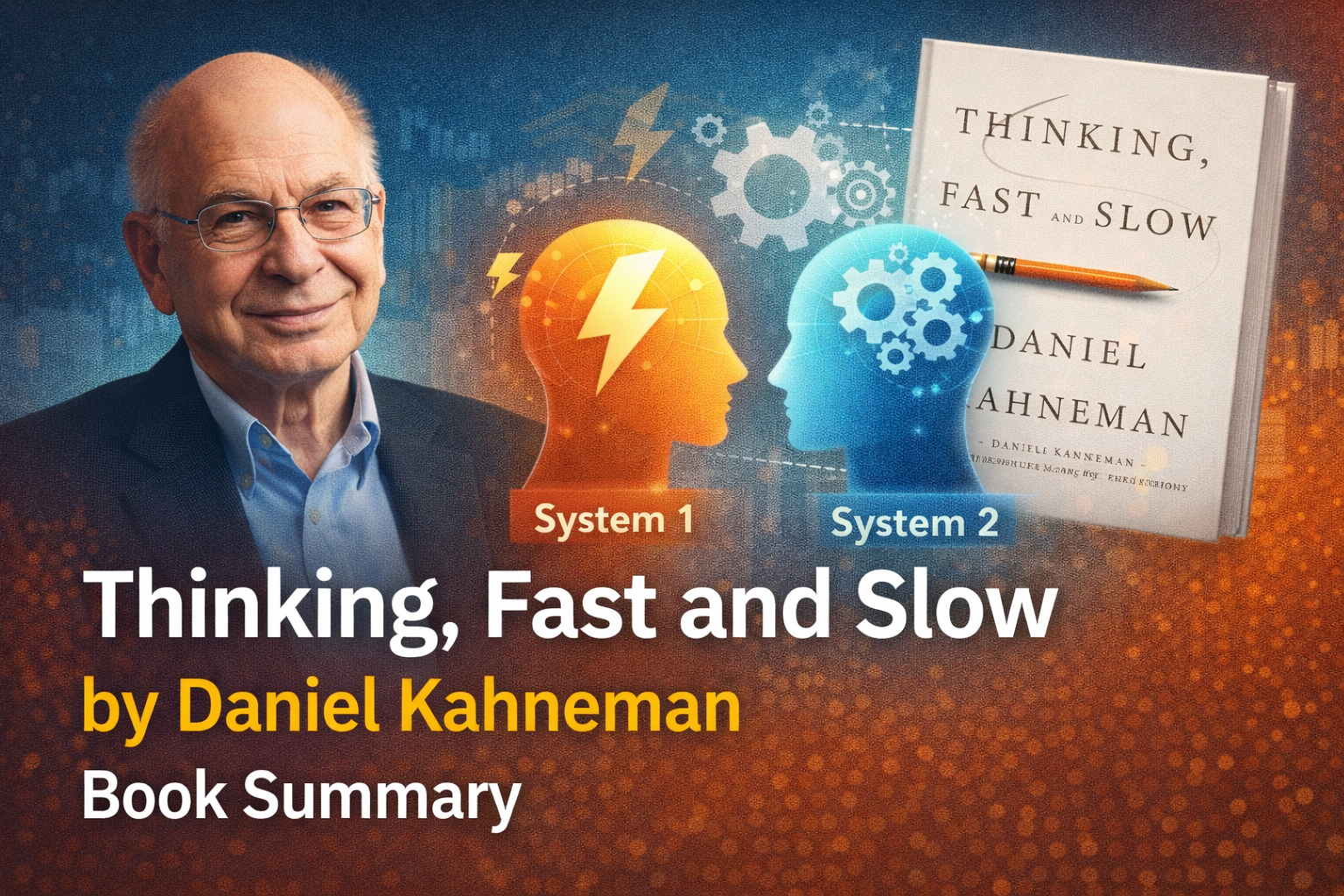
- What you’ll read: Introduction to System 1 (fast, intuitive, emotional) and System 2 (slow, deliberate, logical).
- Key Concepts: How these systems work together and against each other. You’ll learn why your automatic thoughts are so powerful and why your logical mind is often lazy.
Part II: Heuristics and Biases
- What you’ll read: The core of Kahneman’s research. Detailed explanations of the mental shortcuts (heuristics) that lead to predictable errors (biases).
- Key Concepts:
- The Availability Heuristic: Judging probability by how easily examples come to mind.
- The Representativeness Heuristic: Making judgments based on stereotypes.
- Anchoring Effect: Being influenced by an irrelevant initial number.
- Overconfidence: The illusion that we know more than we do.
Part III: Overconfidence
- What you’ll read: A deep dive into the flaws of human intuition, especially among experts.
- Key Concepts: The “illusion of validity,” the “planning fallacy” (why projects are always late and over budget), and why the “stock-picking skill” of most professionals is a myth.
Part IV: Choices
- What you’ll read: Introduction of Prospect Theory (the work that won him the Nobel).
- Key Concepts:
- Loss Aversion: The pain of losing is psychologically about twice as powerful as the pleasure of gaining.
- The Framing Effect: The same problem, framed differently (as a loss vs. a gain), leads to different choices.
- Why we make irrational economic decisions based on emotion.
Part V: Two Selves
- What you’ll read: A fascinating exploration of the difference between our “experiencing self” (who lives in the moment) and our “remembering self” (who tells the story of our life).
- Key Concepts: Why a vacation with a bad ending is remembered as a bad vacation, and what this means for how we think about happiness and well-being.
Part 4: What Does the Book Want to Teach Us? (The Core Message)
The book’s ultimate lesson is not just a list of biases. It’s a fundamental shift in self-awareness.
1. You Are Not Your Thoughts:
Your mind is a machine that produces intuitions. Many of these intuitions are wrong. The book teaches you to question your first instinct, especially for important decisions.
2. The World is Not What it Seems:
Our brains are designed to create a coherent story from limited data. This leads to the “narrative fallacy”—we believe we understand the past and can predict the future, but we ignore the massive role of luck and randomness.
3. To Make Better Decisions, Design Better Systems:
Since we can’t “fix” our biased brains, we must design our environments and processes to account for them.
- For individuals: Use checklists, seek disconfirming evidence, and don’t trust long-term predictions.
- For organizations: Use structured interviews, pre-mortems (imagining a project has failed and figuring out why), and avoid relying on one person’s “gut feel.”
4. Be Humble About Your Judgment:
Experts in fields with high uncertainty (like economics, politics, finance) are often no more accurate than simple algorithms or informed laypeople. The book is a powerful argument for intellectual humility.
Part 5: Who Should Read This Book? (The Audience)
- Professionals: Investors, managers, marketers, doctors, lawyers—anyone whose job involves making judgments under uncertainty.
- Students: Of psychology, economics, business, or anyone interested in human behavior.
- The Curious Self-Improver: Anyone who wants to understand why they make the choices they do and how to think more clearly.
- Leaders & Policymakers: To design policies and systems that work with human nature, not against it.
In Conclusion: Thinking, Fast and Slow is more than a book; it’s an owner’s manual for the human mind. It won’t make you perfectly rational, but it will give you the tools to recognize when you (and others) are being predictably irrational. It’s a challenging but profoundly rewarding read that permanently changes how you see yourself and the world.
- Top 10 Emerging Niche Topics on Youtube in 2026
- India AI Impact Summit 2026 Complete Details
- How to Run Your First Amazon Ads: Complete Beginner’s Guide
- Atomic Habits Summary in Simple Words (With Practical Examples)
- Unlocking Amazon’s Goldmine: Top 10 Selling Categories of 2025 and How to Cash In
-
Thinking, Fast and Slow by Daniel Kahneman – Complete Book Summary
-
Thinking, Fast and Slow by Daniel Kahneman – Complete Book Summary