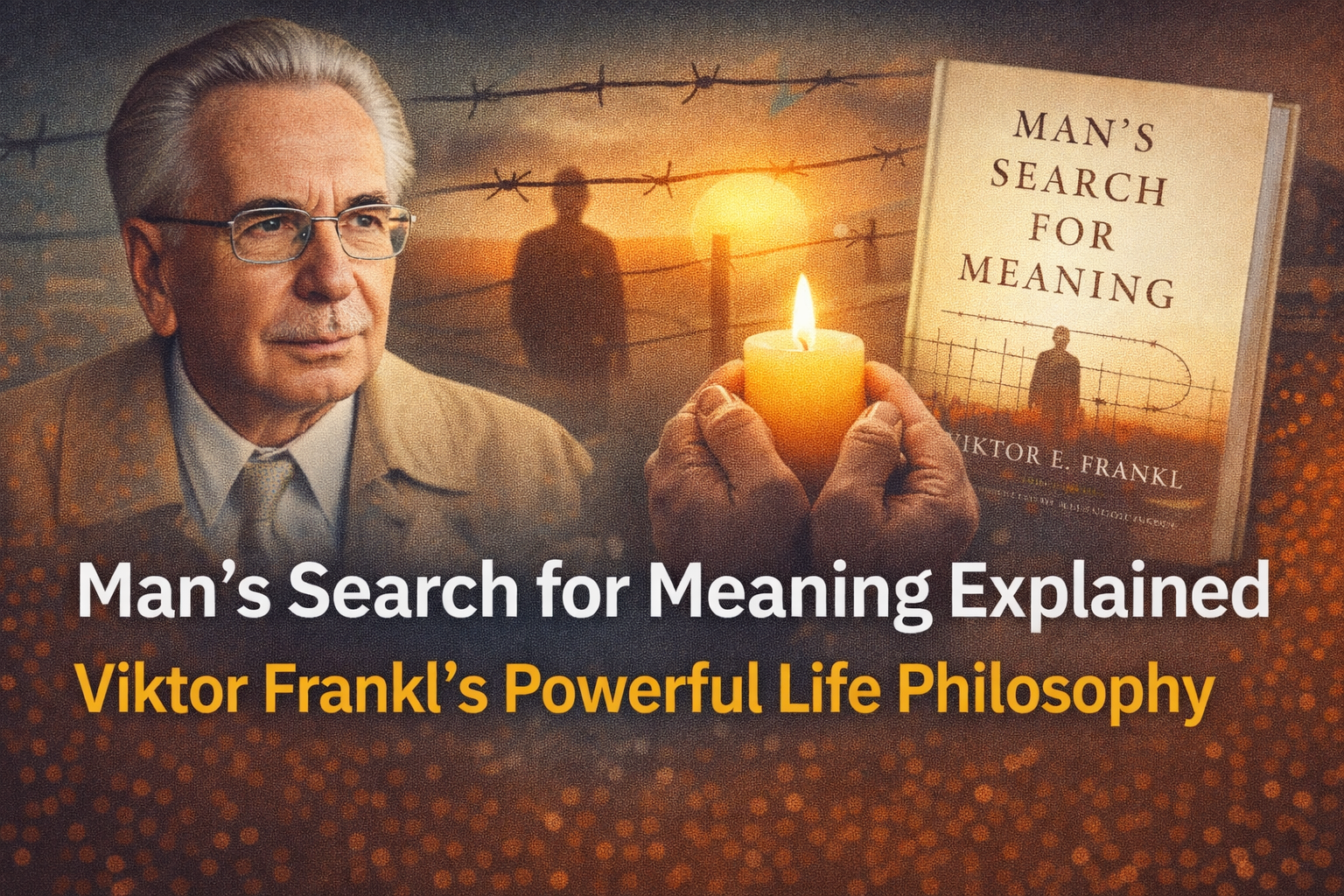
Finding Light in the Darkest Places: A Psychiatrist’s Lesson from the Holocaust.
📖 Book Overview
Man’s Search for Meaning is arguably one of the most influential books of the 20th century. More than a Holocaust memoir, it’s the foundation of Logotherapy—a psychological approach that argues our primary drive in life is not pleasure, but the search for meaning. Published in 1946 in German (originally titled Ein Psycholog erlebt das Konzentrationslager), this slim volume has sold over 16 million copies and been translated into 50+ languages. Its impact spans psychology, philosophy, self-help, and spirituality.
👤 The Author: Viktor Frankl
Who Was He?
Viktor Frankl (1905–1997) was an Austrian neurologist, psychiatrist, and Holocaust survivor. Before World War II, he was already developing his psychological theories. In 1942, he and his family were sent to Nazi concentration camps, where he endured Auschwitz, Dachau, and other camps for three years. His parents, brother, and pregnant wife all perished. Frankl survived, and after liberation, he wrote this book in just nine days—an urgent outpouring of his experience and insight.
Why Did He Write This Book?
Frankl didn’t write to recount horror, but to answer a profound psychological question:
“How did those who survived the camps find a reason to live?”
He wrote to share the single discovery that kept him—and others—alive: Even in the most brutal suffering, meaning is possible. He wanted to prove that human freedom lies not in our circumstances, but in our attitude toward those circumstances.
📚 Chapter-by-Chapter Breakdown
Part One: Experiences in a Concentration Camp
This is not a chronological horror story, but a psychological analysis of camp life.
- The Shock of Arrival: The stripping of identity, possessions, and dignity.
- The Phase of Apathy: Emotional shutdown as a survival mechanism.
- The Search for Meaning: How small moments—a shared crust of bread, a memory of love, a sunset—could provide a “why” to live.
- The Freedom of Attitude: Frankl’s central thesis: “Everything can be taken from a man but one thing… the last of the human freedoms—to choose one’s attitude.”
Key Scene: Frankl, ill and starving, imagines himself after the war, giving a lecture on the psychology of camp life. This future purpose gave him immediate strength.
Part Two: Logotherapy in a Nutshell
Here, Frankl explains the psychotherapy he founded.
- The Will to Meaning: Contrast with Freud (will to pleasure) and Adler (will to power).
- Three Sources of Meaning:
- Work: Creating or accomplishing something.
- Love: Caring for another person.
- Courage in Suffering: Finding meaning even in unavoidable pain.
- The Existential Vacuum: The modern malaise of boredom, apathy, and emptiness—stemming from a lack of meaning.
- Techniques: Dereflection (shifting focus away from yourself) and Paradoxical Intention (facing fears with humor).
Postscript: The Case for Tragic Optimism
Added later, this section argues we can say “Yes to life” despite pain, guilt, and death by finding meaning in all circumstances.
🎯 Who Should Read This Book?
This book is essential for:
- Those Facing Suffering: Grief, illness, depression, or major life challenges.
- Seekers & Questioners: Anyone asking, “What is my purpose?”
- Psychology & Philosophy Students: A cornerstone of existential therapy.
- Leaders & Coaches: To help others find motivation beyond material rewards.
- Every Human: Because suffering is universal, and so is the search for meaning.
Avoid if: You want a linear, historical memoir of the Holocaust. This is a psychological and philosophical work first.
💡 What We Can Learn: Key Takeaways
1. Meaning is Your Lifeline
Frankl observed that prisoners who lost meaning quickly died. Those who held onto a purpose—seeing a loved one again, finishing a book, helping others—often survived against impossible odds.
2. Freedom is in Your Mind
Nazis controlled every external aspect of life, but they could not control how prisoners interpreted their suffering. Your final freedom is your choice of response.
3. Suffering Can Have Meaning
Frankl does not glorify suffering. But he insists that when suffering is unavoidable, we can transform it into achievement by bearing it with dignity.
“What is to give light must endure burning.”
4. Don’t Aim at Success
A core principle of Logotherapy: Success, like happiness, cannot be pursued; it must ensue as the unintended side effect of dedication to a cause greater than oneself.
5. Love is the Ultimate Connection
Frankl’s most moving passages describe how thoughts of his wife gave him strength. Love allows us to see the eternal in another person, transcending even death.
✅ Should You Read This Book?
Yes, if you want:
- A short, profound read (under 200 pages) that stays with you for life.
- Psychological insight backed by unimaginable real-life testing.
- A framework to face hardship with resilience.
- To answer not just “How to live?” but “Why to live?”
No, if you expect:
- A traditional self-help book with bullet-pointed action steps.
- A detailed historical account of the Holocaust.
📝 Closing Thoughts: What This Book Teaches Us
Man’s Search for Meaning is not a depressing book—it’s a profoundly hopeful one. It tells us:
- Life has meaning under any condition. Even in suffering.
- We are not victims of our past or present. We are authors of our response.
- The question is not “What do I want from life?” but “What does life want from me?”
Frankl’s legacy is a challenge: To live with tragic optimism—to see potential meaning in every moment, especially the painful ones.
“Those who have a ‘why’ to live, can bear with almost any ‘how’.”
—Nietzsche, quoted by Frankl
🛒 Your Next Step
If this resonates, read the book slowly. Underline it. Reflect. It’s a book to experience, not just read. Then ask yourself: “In my current situation, what meaning can I find or create?”
For your blog readers: Encourage them to share their “why” in the comments. How do they find meaning in daily life or in challenges?