How Our Ability to Believe in Fiction Created Civilization—And Everything In It.
The Ultimate Origin Story of Our Species
At a Glance:
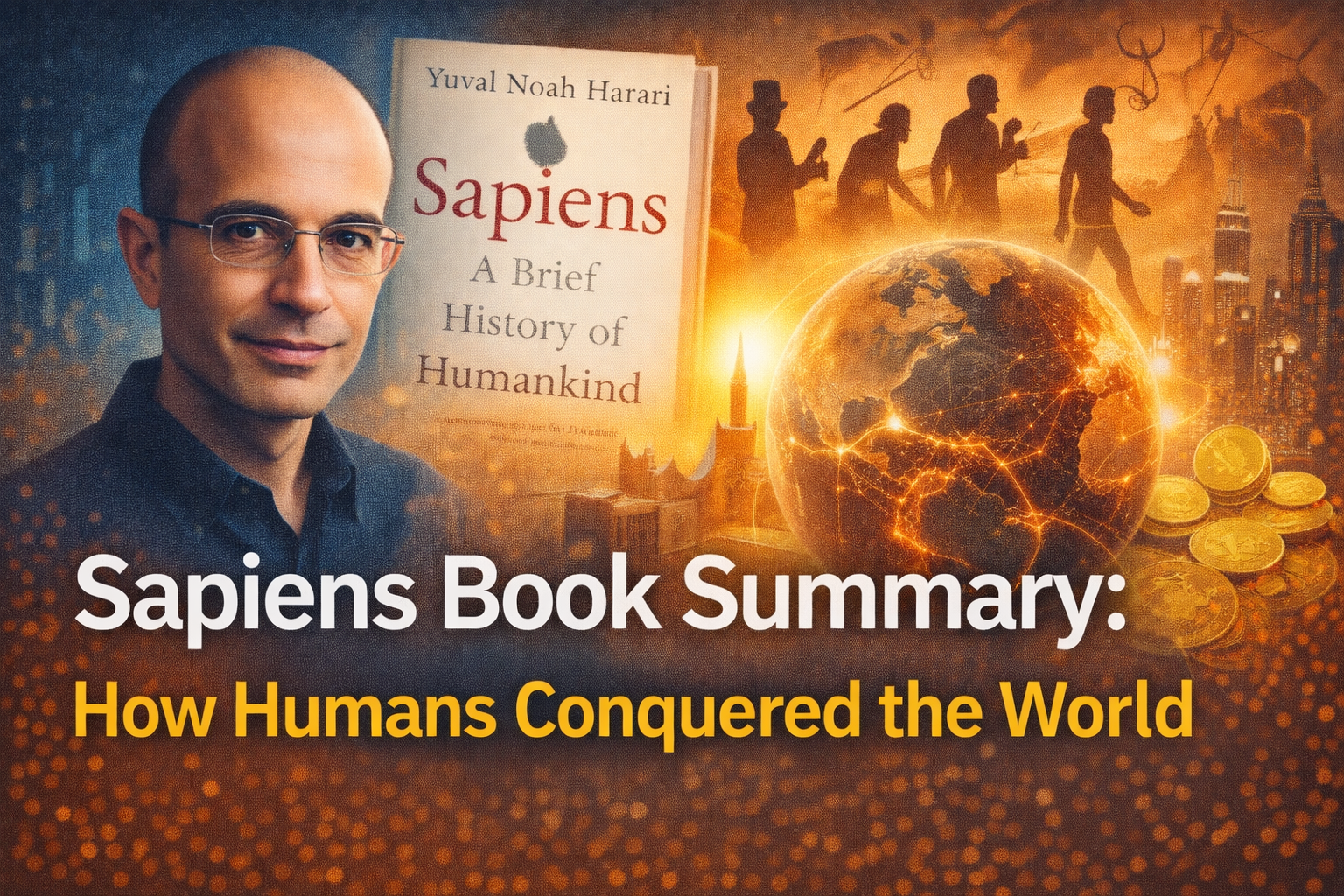
- Book: Sapiens: A Brief History of Humankind
- Author: Yuval Noah Harari (Israeli historian, PhD from Oxford)
- Published: 2011 (Hebrew), 2014 (English)
- Key Idea: Humans rule the world because we alone can believe in shared fictions.
The Author’s Mission: Why Harari Wrote This Book
Yuval Noah Harari didn’t just want to recount history—he wanted to rewrite how we understand it. Trained as a medieval military historian, he grew frustrated with history’s narrow focus on kings, wars, and dates. He asked bigger questions:
“Why did Homo sapiens—a relatively weak, unimpressive ape—become the planet’s dominant species?”
“Why did we create empires, money, gods, and laws?”
“And are we happier now than our hunter-gatherer ancestors?”
Harari wrote Sapiens to give us the “big picture”—connecting biology, anthropology, economics, and psychology into one gripping narrative. He’s not just telling us what happened, but why it matters today.
📖 The Book’s Structure: 4 Revolutions That Made Us
Harari organizes human history into four game-changing revolutions:
1. The Cognitive Revolution (70,000 years ago)
Our Secret Weapon: Fiction
- While other animals communicate about reality (“Lion! Run!”), humans gained the unique ability to talk about things that don’t exist.
- Shared myths—gods, nations, human rights, money—allowed large numbers of strangers to cooperate flexibly.
- Example: 50,000 chimpanzees could never build a spaceship. But 50,000 humans who believe in “NASA” and “science” can.
What changed: We became storytellers. Religion, trade networks, and social norms emerged.
2. The Agricultural Revolution (12,000 years ago)
History’s Biggest Fraud?
- We didn’t domesticate wheat—wheat domesticated us.
- Hunter-gatherers worked about 35 hours/week, ate varied diets, and rarely starved. Farmers worked dawn-to-dusk, ate mostly grains, and faced famine.
- The trap: Farming produced more food → population exploded → needed more farming → couldn’t go back.
What changed: We traded quality of life for quantity of humans. Private property, hierarchy, and patriarchy emerged.
3. The Unification of Humankind
The March Toward Globalization
- Three forces gradually united scattered human cultures:
- Money: The ultimate shared fiction. Everyone believes in gold, dollars, or Bitcoin.
- Empires: Conquerors spread universal ideas and systems.
- Universal Religions: Beliefs that claim truth for all humans (Christianity, Islam, Buddhism, capitalism, communism).
What changed: Isolated cultures merged into today’s interconnected global system.
4. The Scientific Revolution (500 years ago)
The Discovery of Ignorance
- Pre-modern humans believed everything important was already known. Modern science begins with admitting: “We don’t know.”
- Science + capitalism + imperialism = explosive growth.
- The deal: Science gave empires power → empires funded more science.
What changed: We stopped looking backward to sacred texts and started looking forward to new discoveries. Growth became humanity’s new goal.
Harari’s Most Provocative Insights
Money is Trust Made Flesh
- A dollar bill has no intrinsic value. Its power comes from shared belief.
- Money is the only thing everyone trusts, even if they hate each other’s gods or governments.
Empires Were Surprisingly Effective
- While brutal, empires spread ideas, technology, and administration systems.
- Most modern nations (India, US, China) are former empires or their products.
We Haven’t Gotten Happier
- Harari’s haunting question: Are we happier than foragers?
- More power ≠ more happiness. The agricultural revolution may have made life worse for the average human.
- Today, we have unprecedented comfort but also unprecedented anxiety, loneliness, and meaning crises.
The Future: From Natural Selection to Intelligent Design
- We’re nearing the next revolution: upgrading Homo sapiens.
- Through biotechnology and AI, we may soon design our own descendants—ending “human history” and beginning something entirely new.
Who Should Read Sapiens?
Read This Book If You:
- ❓ Wonder why the world is organized as it is
- 🏛️ Study history, anthropology, or sociology
- 💼 Work in business, tech, or global organizations
- 🌍 Want to understand current events in deep historical context
- 🤔 Enjoy big, provocative ideas that challenge conventional wisdom
Skip This Book If You:
- Prefer traditional, fact-heavy history books
- Want a purely scientific account (Harari mixes science with speculation)
- Dislike having your fundamental beliefs questioned
What We Learn: The 5 Core Takeaways
- Fiction is humanity’s superpower. Our ability to create and believe shared stories (gods, laws, corporations) enabled mass cooperation.
- Progress isn’t always progress. The agricultural revolution was a “trap” that made life harder for most individuals.
- Money, empires, and religion are the glue. These three forces gradually unified all humans into today’s global system.
- Science works because it admits ignorance. Unlike previous belief systems, science thrives on saying “I don’t know.”
- We’re about to become gods. Having conquered nature, our next project is to upgrade ourselves—with unpredictable consequences.
Final Verdict: Why This Book Matters Today
Sapiens is more than a history book—it’s a mirror for our species. In 500 pages, Harari explains:
- Why we believe in nations and money
- How capitalism and science became our dominant religions
- Why we’re both the most powerful and most anxious species ever
- What might come next as we start editing our own DNA
The Ultimate Lesson: We rule the world not because we’re strongest or smartest, but because we’re the best storytellers. Every system we live by—law, economy, politics—exists only in our collective imagination. Once we understand this, we can start imagining better systems.
Your Reading Guide
For Blog Readers:
“If you’ve ever wondered why humans build pyramids, fight wars, or create cryptocurrencies—this book connects all the dots. Harari doesn’t just tell you what happened; he changes how you see everything from your morning coffee (a legacy of imperialism) to your smartphone (a product of science-capitalism).
Warning: You’ll never look at history—or the modern world—the same way again.”
Best Way to Read:
- Read with a pencil—you’ll want to underline provocative ideas
- Discuss with friends—the best ideas are debated, not just absorbed
- Follow with Harari’s sequels: Homo Deus (our future) and 21 Lessons (present challenges)