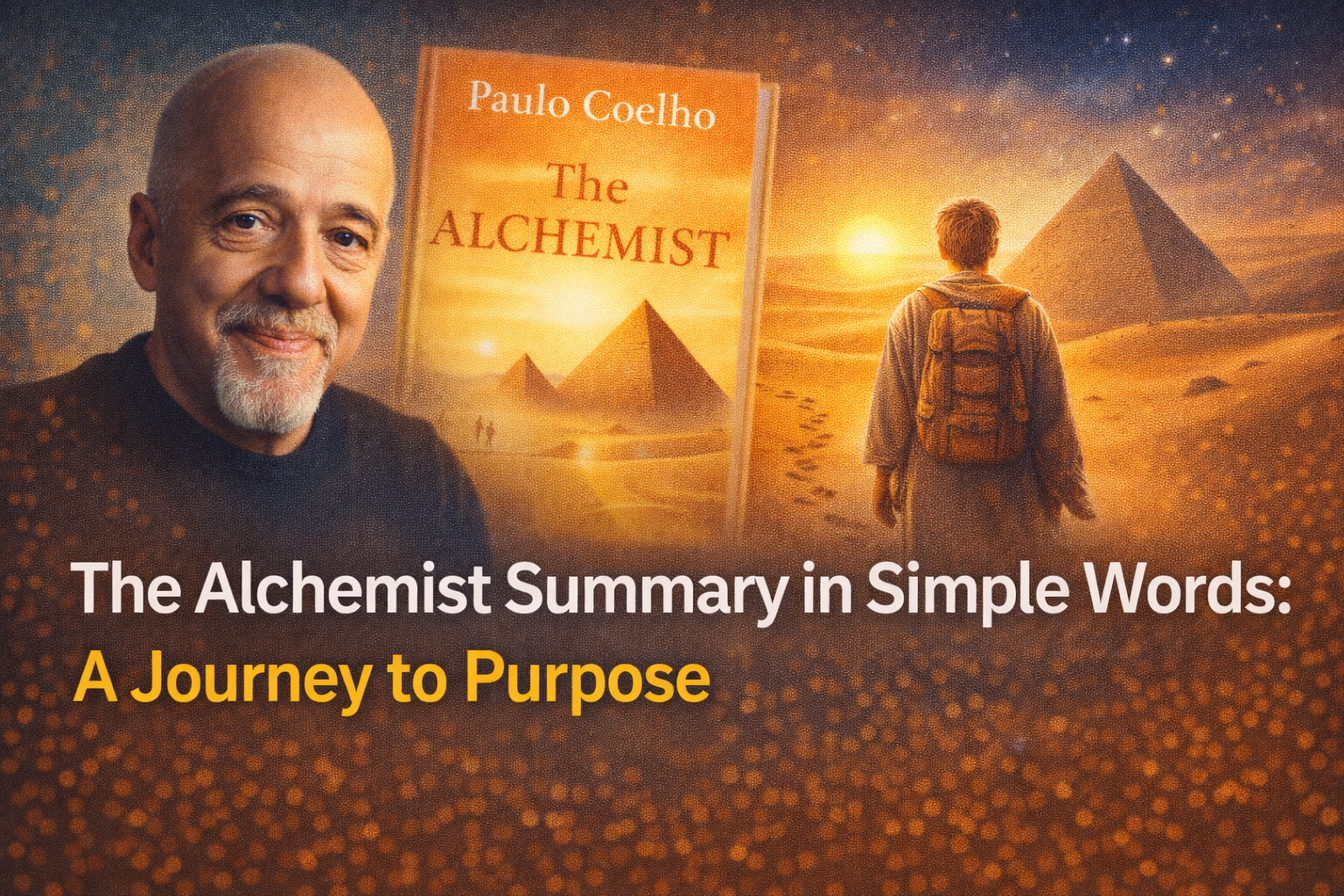
A Fable About Listening to Your Heart and Following Your Personal Legend.
The Alchemist Summary in Simple Words: A Journey to Purpose. The Simple Truth of The Alchemist
The Alchemist isn’t just a novel—it’s a parable about listening to your heart and chasing your dreams. Written by Brazilian author Paulo Coelho and published in 1988, this short book has sold over 150 million copies worldwide. Why? Because in simple, poetic language, it answers the most human question: “What should I do with my life?”
The Author’s Story
: Why Coelho Wrote This Book
Paulo Coelho had a dramatic life before becoming a writer. He was:
- Institutionalized by his parents for wanting to be a writer
- A hippie traveling through South America
- A lyricist for famous Brazilian musicians
- A pilgrim walking the 500-mile Road to Santiago
He wrote The Alchemist in just two weeks, channeling a spiritual experience. He believed the story was already written in his soul—he just had to transcribe it. The book initially sold poorly (only 900 copies in the first year), but through word of mouth, it became a global phenomenon.
Coelho’s Purpose: To show that every person has a “Personal Legend”—a destiny they’re meant to fulfill—and that the universe conspires to help those brave enough to pursue it.
Chapter-by-Chapter Journey (Simplified)
Part 1: The Shepherd’s Restless Heart
Santiago, an Andalusian shepherd boy, has a recurring dream about treasure near the Egyptian pyramids. He meets Melchizedek, the King of Salem, who tells him about Personal Legends and gives him two stones—Urim and Thummim—to help read omens.
Key Lesson: “When you want something, all the universe conspires to help you achieve it.”
Part 2: The African Adventure
Santiago sells his sheep and travels to Africa, where he’s immediately robbed. Working in a crystal shop to earn money, he learns:
- Even if you’re moving slowly toward your dream, you’re closer than if you stood still
- Fear of failure is worse than failure itself
Part 3: The Desert Wisdom
Joining a caravan across the Sahara, Santiago meets an Englishman obsessed with alchemy books. Through him, Santiago learns that alchemy isn’t about turning lead to gold—it’s about spiritual transformation.
Part 4: Meeting the Alchemist
In an oasis, Santiago meets Fatima, his true love, and must choose between staying with her or continuing his quest. The Alchemist appears and teaches him:
- Listen to your heart (it knows everything)
- Live in the present (the past is gone, the future unknown)
- Fear is the only obstacle
Part 5: The Pyramids and the Truth
After surviving tribal wars and transforming into wind through spiritual power, Santiago finally reaches the pyramids. Digging for treasure, he’s beaten by thieves who mock his dream. One thief says: “I had a recurrent dream too—about treasure buried under a sycamore tree in Spain.”
The Twist: Santiago returns home—to the very church where he first dreamed—and finds the treasure buried there.
What Each Character Represents
| Character | What They Symbolize |
|---|---|
| Santiago | Every person searching for purpose |
| Melchizedek | The initial push/divine guidance |
| Crystal Merchant | Those who dream but fear change |
| Englishman | Those who seek answers only in books |
| Fatima | Love that supports, not hinders, dreams |
| The Alchemist | The wise teacher within all of us |
| The Pyramids | The distant goal that transforms us |
The 5 Core Lessons in Simple Words
1. Your Personal Legend is Real
Everyone is born with a purpose. It’s not about becoming famous or rich—it’s about becoming who you’re meant to be.
2. The Language of the World
Everything in the universe is connected. Omens (signs) guide those who pay attention. A failed job, a chance meeting, a recurring thought—these might be directions.
3. Fear is the Only Enemy
As the Alchemist says: “Tell your heart that the fear of suffering is worse than the suffering itself.” Most dreams die from “what if I fail?” thinking.
4. Love Doesn’t Hold You Back
True love (like Fatima’s) says: “Go, fulfill your destiny. If it’s meant to be, I’ll be here when you return.” False love says: “If you love me, you’ll stay.”
5. The Treasure Was Never Just Gold
The real treasure wasn’t in Egypt—it was the person Santiago became through his journey. The gold was just a bonus.
Who Should Read This Book?
READ THIS BOOK IF YOU:
- Feel stuck or uncertain about your path
- Need courage to make a big life change
- Want a simple, uplifting story about purpose
- Are spiritual but not religious
- Enjoy parables and timeless wisdom
MAYBE SKIP THIS BOOK IF YOU:
- Prefer complex plots with twists
- Dislike spiritual or “fate-based” narratives
- Want practical step-by-step advice
Common Questions Answered
Q: Is this a religious book?
A: It’s spiritual but not religious. It talks about God, the Soul of the World, and destiny, but not in any organized religion’s framework.
Q: Is it really that simple—just follow your dreams?
A: Coelho shows it’s simple but not easy. Santiago faces robbery, war, doubt, and nearly dies. The path tests you.
Q: What’s up with the ending?
A: The treasure being at home means: Your purpose isn’t somewhere else—it’s in becoming who you truly are. Sometimes the journey outward leads you inward.
Final Takeaway: Why This Book Changes Lives
The Alchemist works like a mirror: Santiago’s journey reflects your own. When you read it, you’ll inevitably ask:
- “What’s my Personal Legend?”
- “What omens am I ignoring?”
- “What fear is holding me back?”
The book doesn’t give you answers—it awakens the questions you’ve been avoiding.
How to Get the Most from This Book
- Read it slowly—it’s short but dense with meaning
- Mark passages that resonate with you
- Ask yourself after each section: “What would my version of this look like?”
- Re-read it at different life stages—it means something new each time
Your Turn: The One Question That Matters
After closing the book, ask yourself this one question that summarizes everything:
“If I knew I couldn’t fail, what would I begin today?”
Your answer—that whisper in your heart—is your journey beginning.
- Top 10 Emerging Niche Topics on Youtube in 2026
- India AI Impact Summit 2026 Complete Details
- How to Run Your First Amazon Ads: Complete Beginner’s Guide
- Atomic Habits Summary in Simple Words (With Practical Examples)
- Unlocking Amazon’s Goldmine: Top 10 Selling Categories of 2025 and How to Cash In