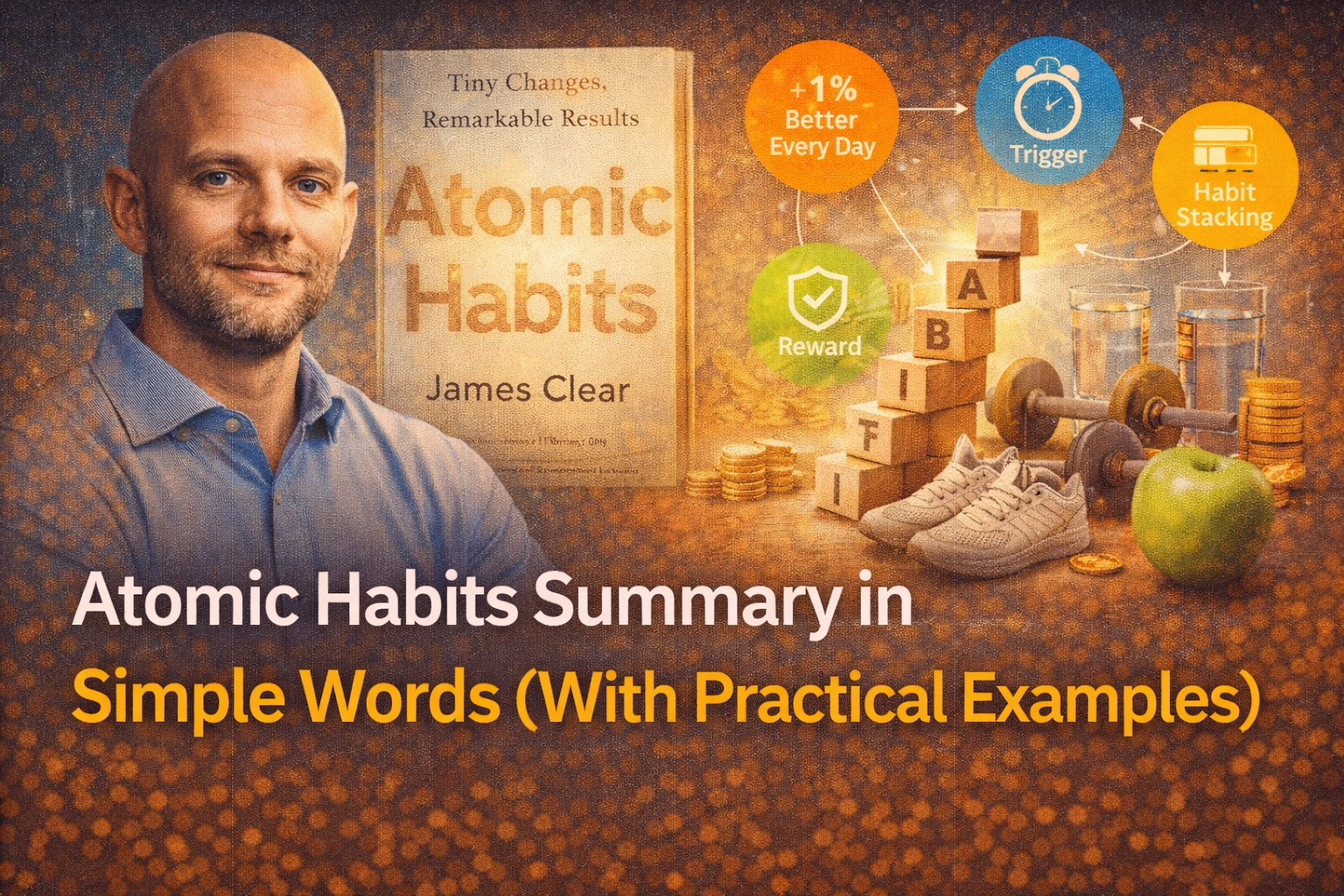
Tiny Changes, Remarkable Results: Stop Chasing Goals and Start Building Systems.
⚡ The Ultimate Guide to Building Good Habits and Breaking Bad Ones
📋 Book Overview
| Aspect | Details |
|---|---|
| Title | Atomic Habits: An Easy & Proven Way to Build Good Habits & Break Bad Ones |
| Author | James Clear |
| Published | October 16, 2018 |
| Pages | 320 |
| Genre | Self-Help / Personal Development / Psychology |
| Copies Sold | Over 15 million worldwide |
| Key Phrase | “1% better every day” |
About the Author: Who is James Clear?
His Story: From Tragedy to Transformation
James Clear’s journey to becoming the world’s leading expert on habit formation began with a devastating accident.
- Age 16: He was hit in the face with a baseball bat during a game, suffering a traumatic brain injury, multiple skull fractures, and a seizure on the field.
- Recovery: He fell into a coma, woke up struggling with basic functions, and had to relearn everyday tasks.
- The Turning Point: To rebuild his life, Clear had to master tiny habits—small, consistent actions that slowly rebuilt his strength, focus, and identity.
- Result: He not only recovered but became an All-American academic athlete at Denison University.
Why He Wrote This Book
Clear started writing about habits on his blog, and his articles went viral. He realized that people desperately wanted a system, not just motivation. After years of research, experimentation, and writing, he compiled everything into Atomic Habits—not just to share success stories, but to provide a practical, step-by-step framework anyone could use.
His Mission: “To show that success is not about dramatic transformations, but the compound growth of small, daily habits.”
What is This Book Trying to Teach You?
At its core, Atomic Habits answers three fundamental questions:
- Why do we repeat bad habits even when we want to change?
- How can we make good habits stick without relying on willpower?
- What separates those who transform their lives from those who stay stuck?
The Big Idea: Tiny changes (“atomic habits”) don’t produce immediate results, but compounded over time, they create remarkable transformations. You don’t rise to the level of your goals—you fall to the level of your systems.
Complete Chapter-by-Chapter Breakdown
The book is divided into 6 sections with 20 concise chapters. Each builds on the last to create a complete habit-building system.
SECTION 1: The Fundamentals (Why Tiny Changes Make a Big Difference)
Chapter 1: The Surprising Power of Atomic Habits
- Core Concept: Habits are the compound interest of self-improvement. A 1% improvement daily leads to a 37x improvement over a year.
- The Plateau of Latent Potential: Results are delayed. Like an ice cube not melting until 32°F, your habits don’t show results until you cross a critical threshold.
- Key Quote: “Success is the product of daily habits—not once-in-a-lifetime transformations.”
Chapter 2: How Your Habits Shape Your Identity (and Vice Versa)
- The Two-Step Change Process:
- ❌ Outcome-based habits: “I want to lose weight” (focus on results)
- ✅ Identity-based habits: “I want to become a healthy person” (focus on who you become)
- The Habit Loop: Every action you take is a vote for the type of person you wish to become.
- Practical Step: Ask yourself: “What would a healthy person do? A writer? A leader?”
Chapter 3: How to Build Better Habits in 4 Simple Steps
- The 4-Step Habit Loop:
- Cue → Trigger that initiates behavior
- Craving → Motivation to act
- Response → The actual habit
- Reward → Satisfaction that reinforces the loop
- The Four Laws of Behavior Change (the book’s entire framework):
- Make it OBVIOUS (Cue)
- Make it ATTRACTIVE (Craving)
- Make it EASY (Response)
- Make it SATISFYING (Reward)
SECTION 2: The 1st Law – Make It Obvious
Chapter 4: The Man Who Didn’t Look Right
- Pointing-and-Calling: The Japanese railway system uses a method where workers point and call out actions to reduce errors. You can do the same with habits.
- The Habits Scorecard: List your daily habits and mark them as + (good), – (bad), or = (neutral). Awareness comes before change.
Chapter 5: The Best Way to Start a New Habit
- Implementation Intention: A specific plan for when and where you’ll act.
- Formula: “I will [BEHAVIOR] at [TIME] in [LOCATION].”
- Example: “I will meditate for 1 minute at 7 AM in my bedroom.”
Chapter 6: Motivation is Overrated; Environment Matters More
- Design your environment for success:
- Make cues of good habits obvious (place your guitar in the living room)
- Make cues of bad habits invisible (hide your phone in another room)
- One Space, One Use: Train your brain to associate specific places with specific habits.
Chapter 7: The Secret to Self-Control
- Key Insight: Discipline is easier when you avoid temptation entirely.
- Remove the cue: If you can’t resist junk food, don’t keep it in the house.
- Willpower is short-term; environment design is forever.
SECTION 3: The 2nd Law – Make It Attractive
Chapter 8: How to Make a Habit Irresistible
- Temptation Bundling: Pair an action you WANT to do with an action you NEED to do.
- Formula: “After [HABIT I NEED], I will [HABIT I WANT].”
- Example: Listen to your favorite podcast only while exercising.
Chapter 9: The Role of Family and Friends in Shaping Your Habits
- We imitate:
- The close (family and friends)
- The many (the tribe)
- The powerful (celebrities, leaders)
- Join a culture where your desired behavior is normal. If you’re surrounded by readers, reading becomes easier.
Chapter 10: How to Find and Fix the Causes of Your Bad Habits
- Reframe your mindset: Not “I have to wake early” but “I get to see the sunrise.”
- Highlight the benefits of good habits and the costs of bad ones.
SECTION 4: The 3rd Law – Make It Easy
Chapter 11: Walk Slowly, but Never Backward
- Motion vs. Action:
- Motion: Planning, learning, strategizing
- Action: Actually doing the behavior
- The key is repetition, not perfection. Habits form through practice, not planning.
Chapter 12: The Law of Least Effort
- Reduce friction: Make good habits so easy you can’t say no.
- Example: Want to floss? Start with just one tooth.
- Prime your environment: Prepare your space in advance (lay out workout clothes the night before).
Chapter 13: How to Stop Procrastinating with the Two-Minute Rule
- The Rule: Any habit can be started in under 2 minutes.
- “Read before bed” → “Read one page”
- “Run 5K” → “Put on running shoes”
- Master the art of showing up. Once you start, momentum often carries you forward.
Chapter 14: How to Make Good Habits Inevitable and Bad Habits Impossible
- Commitment devices: Choices in the present that lock in better behavior in the future.
- Example: Use a smaller plate to control portions.
- Example: Buy a timed lock for your phone.
SECTION 5: The 4th Law – Make It Satisfying
Chapter 15: The Cardinal Rule of Behavior Change
- Immediate reward vs. delayed reward: Good habits give future benefits; bad habits give instant pleasure.
- Solution: Add immediate gratification to good habits (track your progress, treat yourself after).
- Habit tracking: The most satisfying way to measure progress. Each checkmark reinforces your identity.
Chapter 16: How to Stick with Good Habits Every Day
- Never miss twice. Missing once is an accident; missing twice is the start of a new habit.
- Keep the streak alive, but if you break it, get back on track immediately.
Chapter 17: An Accountability Partner Can Change Everything
- Make bad habits painful in the short term:
- Create a habit contract with consequences
- Tell someone your goals; social pressure works
SECTION 6: Advanced Tactics (How to Go from Being Merely Good to Being Truly Great)
Chapter 18: The Truth About Talent (When Genes Matter and When They Don’t)
- Work with your personality, not against it. Choose habits that fit your natural inclinations.
- Explore → Exploit: Try many things, then double down on what works for you.
Chapter 19: The Goldilocks Rule (How to Stay Motivated in Life and Work)
- Motivation peaks at tasks of “just manageable difficulty.”
- Too easy = boredom
- Too hard = anxiety
- Just right = flow
Chapter 20: The Downside of Creating Good Habits
- Habits can become ruts. Once mastered, you stop improving.
- Review and reflect regularly: Habits should serve you, not run you.
The Four Laws of Behavior Change (Summary Table)
| Law | Question | Good Habit Strategy | Bad Habit Strategy |
|---|---|---|---|
| 1st: Make it Obvious | How can I see the cue? | Implementation intention, habit stacking, environment design | Make it invisible (remove cues) |
| 2nd: Make it Attractive | How can I want it? | Temptation bundling, join a culture, reframe mindset | Make it unattractive (highlight costs) |
| 3rd: Make it Easy | How can I do it? | Reduce friction, 2-minute rule, prime environment | Make it difficult (increase friction) |
| 4th: Make it Satisfying | How can I enjoy it? | Immediate rewards, habit tracking, celebrate | Make it unsatisfying (accountability partner) |
Who Should Read This Book?
| Read This Book If You… | Skip If You… |
|---|---|
| Struggle to stick with new habits | Want quick fixes without effort |
| Feel stuck in self-defeating patterns | Prefer abstract theory over practical steps |
| Want evidence-based, science-backed advice | Already have a perfect system (but who does?) |
| Are a coach, teacher, or leader helping others | Expect overnight transformation |
| Love clear, actionable frameworks | Dislike structured systems |
What We Learn: The 7 Core Takeaways
1. Habits Compound
A 1% improvement daily = 37x better over a year. Small changes matter.
2. Focus on Systems, Not Goals
Goals are about results; systems are about processes. Winners and losers have the same goals—systems make the difference.
3. Change Your Identity First
Don’t ask “What do I want to achieve?” Ask “Who do I want to become?”
4. Design Your Environment
You don’t need to be motivated; you need a well-designed space. Make good habits easy, bad habits hard.
5. The Two-Minute Rule
Any habit can be started in 2 minutes. Master the art of showing up.
6. Immediate Rewards Matter
We’re wired for instant gratification. Attach immediate pleasure to long-term good habits.
7. Never Miss Twice
Perfection isn’t required. Consistency is. If you slip, get back on track immediately.
Famous Quotes from the Book
“You do not rise to the level of your goals. You fall to the level of your systems.”
“Every action you take is a vote for the type of person you wish to become.”
“Habits are the compound interest of self-improvement.”
“The most effective way to change your habits is to focus not on what you want to achieve, but on who you wish to become.”
“Success is not a goal to reach or a finish line to cross. It is a system to improve, an endless process to refine.”
Practical Application: How to Start Today
Step 1: Identify one habit you want to build.
Step 2: Apply the Four Laws:
- Make it obvious (set a specific time/place)
- Make it attractive (pair with something you love)
- Make it easy (reduce to 2 minutes)
- Make it satisfying (track and celebrate)
Step 3: Do it for 30 days and watch the compound effect unfold.
Final Verdict: Why This Book Matters
Atomic Habits isn’t just another self-help book—it’s a complete operating manual for human behavior. James Clear has synthesized decades of psychology research into a system so simple that anyone can use it, yet so powerful that it transforms lives.
The Ultimate Lesson: You don’t need to be extraordinary to achieve extraordinary results. You just need to be consistent—making tiny, atomic improvements that compound into remarkable change.
Perfect Companion Reading
If you loved Atomic Habits, read these next:
- The Power of Habit by Charles Duhigg (the science of habit formation)
- Tiny Habits by BJ Fogg (a similar approach from Stanford)
- Deep Work by Cal Newport (focus and productivity)
- Mindset by Carol Dweck (the psychology of growth)
For Blog Readers
“Have you tried building a habit and failed? You’re not lazy—you just don’t have the right system. Atomic Habits gives you that system. Start with one tiny change today. What will it be?”